
Chapter 1: Computer Systems
Covers early computing devices, computer generations, Von Neumann architecture, CPU components, RAM/ROM memory types, software categories, and data communication basics — with solved MCQs and exercises.
View Notes →
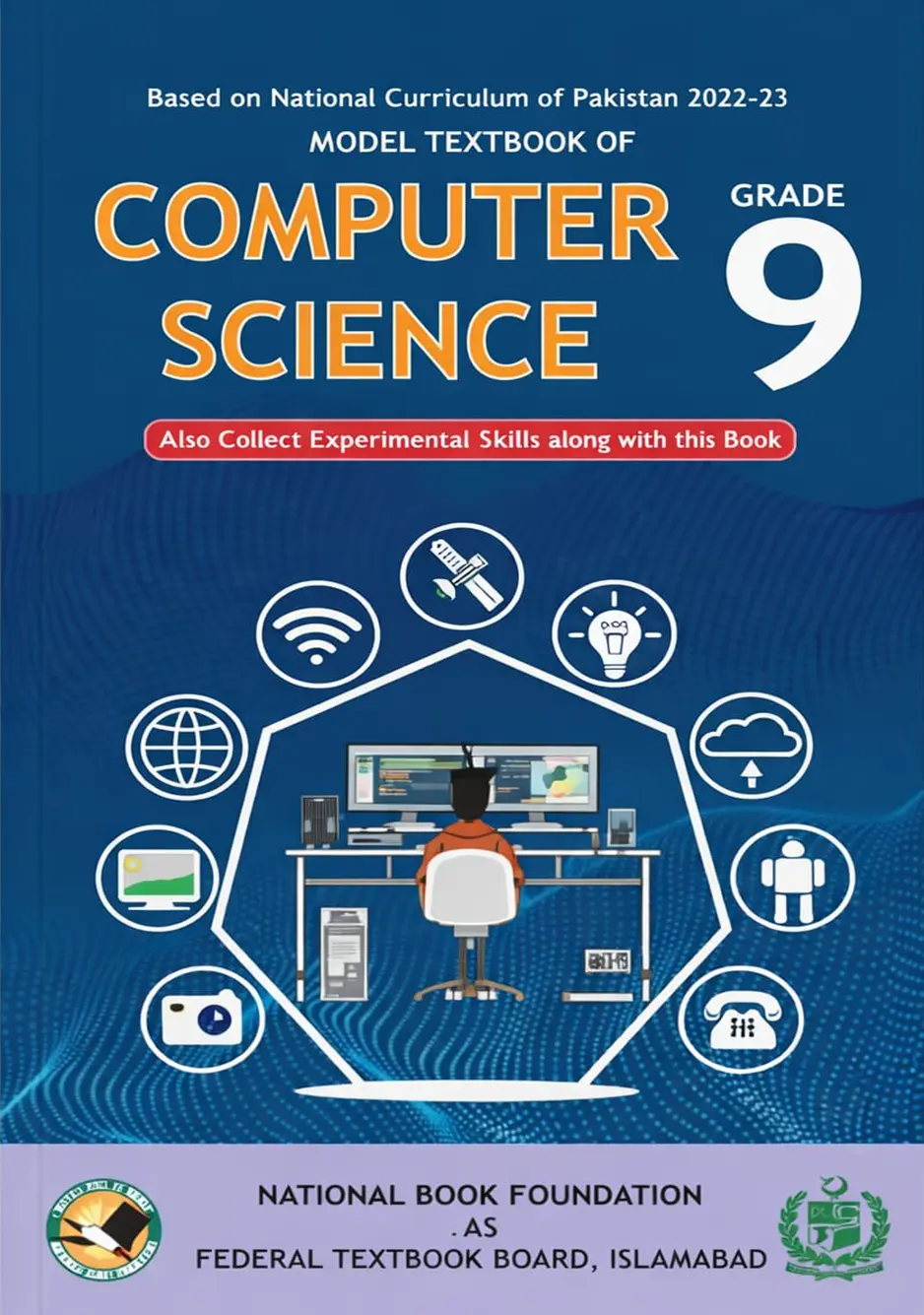
Covers early computing devices, computer generations, Von Neumann architecture, CPU components, RAM/ROM memory types, software categories, and data communication basics — with solved MCQs and exercises.
Explains problem identification (decision, search, counting), the I-P-O model, decomposition and abstraction, and flowchart design — with solved MCQs and exercises for exam prep.
Introduces web development basics — HTML tags, CSS styling, and JavaScript fundamentals like variables, loops, arrays, and functions — with solved MCQs and coding exercises.
Covers Data Science concepts and scope, business problems, data storage and visualization, summary statistics, and the advantages and challenges of Big Data — with solved MCQs.
Explores Artificial Intelligence and Machine Learning, ethical issues in AI tools, real-world AI applications in robotics, healthcare and gaming, and Cloud Computing models.
Covers safe use of digital platforms, responsible hardware/software use, privacy laws, malware and phishing, and the fake-news tradeoff in modern computing.
Covers entrepreneurial skills, design thinking, cost of production and profit, and how to build a business plan including budgeting and promotional strategies.
PrimeStudy's Class 9 Computer Science notes are built directly from the National Book Foundation (NBF) textbook prescribed for the Federal Board (FBISE) 2026-2027 session, and follow the Single National Curriculum (SNC) framework used across Pakistan. Every chapter — from computer architecture to entrepreneurship — is broken down into short, exam-focused explanations, so Class 9 (SSC-I) students can revise quickly instead of re-reading long textbook paragraphs.
The updated syllabus leans heavily on practical computing rather than memorization: you'll move from core hardware concepts like the Von Neumann model straight into hands-on web development with HTML, CSS and JavaScript. Because FBISE now tests Student Learning Outcomes (SLOs) — understanding, not just recall — every set of notes here pairs a plain-language explanation with solved MCQs, short questions and long questions in the same pattern you'll see in the actual paper.
These notes track the Single National Curriculum (SNC) and the SLO framework FBISE introduced for the National Book Foundation's 2026-2027 Computer Science book. If you're on the Punjab Board (PCTB) instead, you can still use the chapters on programming, algorithms and cyber security, since the core content overlaps closely with FBISE.
Yes — these notes follow the updated National Book Foundation (NBF) textbook for Class 9 Computer Science, for the 2026-2027 FBISE session.
The Student Learning Outcomes (SLO) model tests conceptual understanding and practical application rather than straight memorization. These notes are built around that approach.
Yes, each chapter has a PDF download link so you can study offline.
Yes — Chapter 3 covers structural HTML, CSS styling, and introductory JavaScript programming concepts.
There are seven chapters: Computer Systems, Computational Thinking & Algorithms, Programming Fundamentals, Data and Analysis, Applications of Computer Science, Impacts of Computing, and Entrepreneurship.
While built for the FBISE/NBF textbook, Punjab Board (PCTB) students can use them for overlapping topics like programming, algorithms and cyber security.
It's a foundational design framework for electronic computers, covering the CPU, memory unit, buses, and input/output interfaces — explained with labeled diagrams in Chapter 1.
Yes — Chapter 7 covers basic business planning, budgeting, cost of production, and designing a simple tech business model.
Yes — every review question, activity and exercise from the NBF textbook is answered in full, including the MCQs, short questions and long questions.
Yes — FBISE's updated NBF textbook for Class 9 Computer Science follows the Single National Curriculum (SNC) guidelines set for schools across Pakistan.
Yes — chapters like Programming Fundamentals include real HTML, CSS and JavaScript examples you can practice, which also helps with the practical component of the SSC-I exam.
Read the textbook chapter first, go through the definitions and summaries here, then work through the MCQs and short/long questions before checking your answers against the solved versions.
This content is provided for educational support only and is not for sale, redistribution, or commercial use. PrimeStudy does not claim ownership of any government textbook material.