
Chapter 1: Nature of Science in Chemistry
Explore Chemistry as a scientific discipline, its major branches, everyday applications, and the connection between science, technology, engineering, and society.
View Notes →
Explore Chemistry as a scientific discipline, its major branches, everyday applications, and the connection between science, technology, engineering, and society.
Study states of matter, elements, compounds, mixtures, carbon allotropes, solutions, solubility, colloids, and suspensions with their important characteristics.
Learn atomic models from Dalton to the quantum mechanical model, subatomic particles, isotopes, atomic mass, ions, and electronic configurations of atoms and ions.
Understand periods, groups, s- and p-blocks, transition elements, and periodic trends including atomic size, shielding effect, ionization energy, electron affinity, and electronegativity.
Study why atoms form bonds and compare ionic, covalent, coordinate covalent, and metallic bonding along with intermolecular forces such as hydrogen bonding and dipole interactions.
Master empirical and molecular formulas, formula mass, the mole concept, Avogadro's number, mole-mass and mole-particle calculations, and balancing chemical equations.
Understand oxidation and reduction through oxygen, hydrogen, and electron transfer, oxidation states, oxidizing and reducing agents, and methods used to prevent corrosion.
Explore chemical energy, systems and surroundings, exothermic and endothermic reactions, enthalpy, bond energy, activation energy, catalysts, and energy changes in respiration.
Study reversible reactions and dynamic equilibrium, and understand how changes in temperature and heat influence equilibrium in chemical systems.
Compare major acid-base concepts, examine strong and weak acids and bases, the pH scale, acid-base properties, and the behavior of oxides and hydroxides.
Examine atmospheric composition and major air pollutants such as SOx, carbon monoxide, carbon dioxide, methane, and ozone, together with global warming and acid-rain control.
Study water as a solvent, water quality, dissolved substances, treatment of tap water, waterborne diseases, water scarcity in Pakistan, and the environmental effects of fertilizers.
Learn the fundamentals of organic compounds, homologous series, structural formulas, open and closed chains, and important functional groups found in organic molecules.
Study hydrocarbons with emphasis on alkanes, their preparation, important reactions such as halogenation and combustion, and methods including hydrogenation and cracking.
Explore carbohydrates, proteins, lipids, and nucleic acids including DNA and RNA, together with nutrition, food components, and basic dietary requirements.
Develop laboratory measurement skills through SI units, conversions, scientific notation, accuracy and precision, and the use of pipettes, burettes, gas syringes, and balances.
Learn methods for separating and purifying substances, including evaporation, fractional, steam and vacuum distillation, filtration, and crystallization.
Study laboratory tests for identifying gases such as ammonia, carbon dioxide, chlorine, hydrogen, oxygen and sulphur dioxide, along with flame tests for metal ions.
Understand stationary and mobile phases, paper chromatography, locating agents, chromatograms, and techniques for separating and identifying unknown substances.
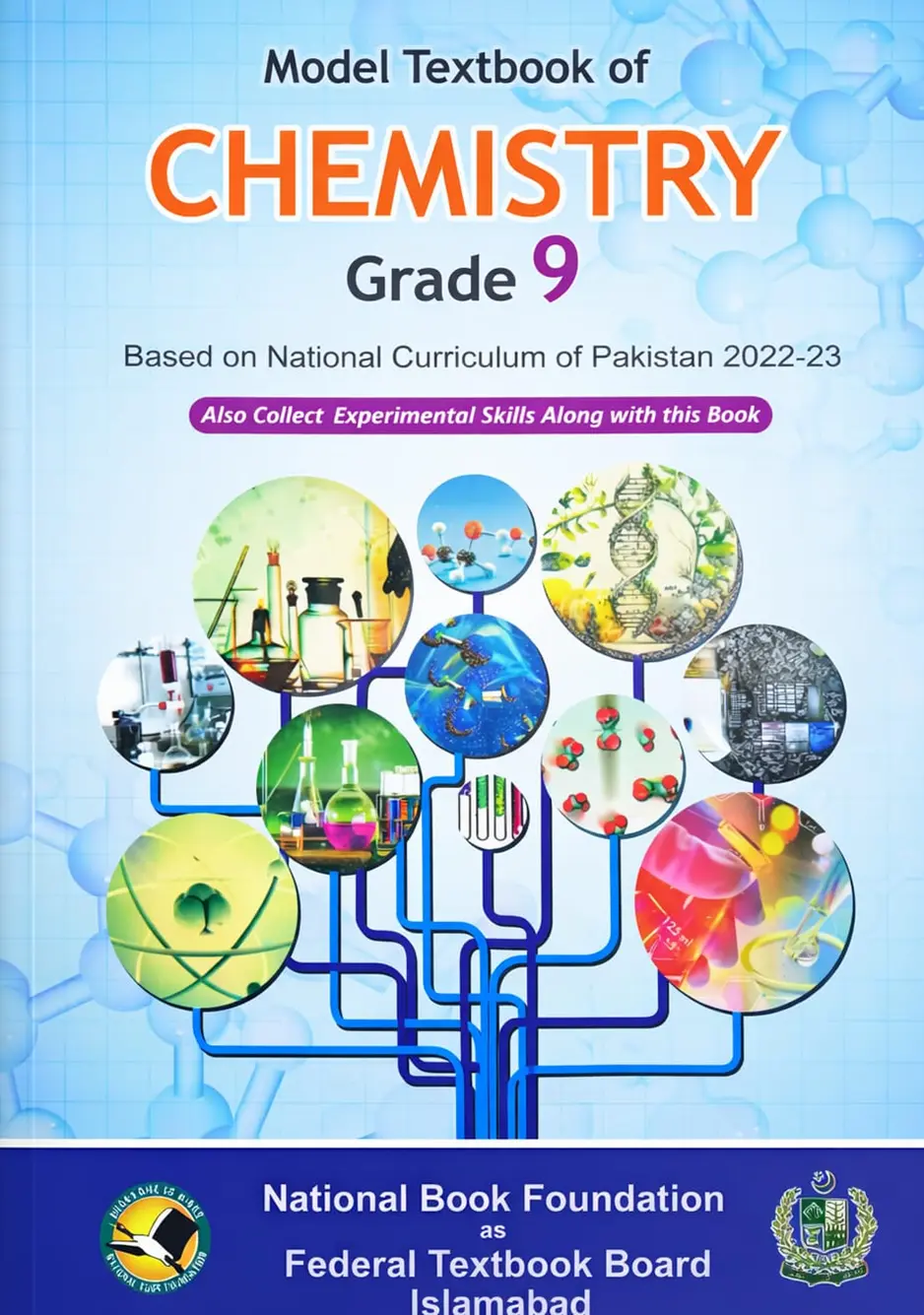
Welcome to PrimeStudy's Class 9 Chemistry notes for the 2026-2027 FBISE session, prepared around the National Book Foundation (NBF) textbook. The material follows the SLO-focused approach of the Federal Board and covers all 19 chapters through concise explanations, solved exercises, conceptual MCQs, important short and long questions, calculations, and practical Chemistry topics.
Chemistry requires more than memorizing definitions and reactions. Students need to understand chemical reasoning, formulas, structures, calculations, laboratory procedures, and the relationships between different concepts. These notes are organized to make those areas easier to revise while providing exam-focused material for FBISE Class 9 preparation.
These Chemistry notes follow the National Curriculum of Pakistan and the Student Learning Outcomes (SLO) approach used by the Federal Board (FBISE). They are based on the National Book Foundation (NBF) Class 9 Chemistry textbook for the 2026-2027 session, with emphasis on conceptual understanding, chemical reasoning, calculations, and practical learning.
Continue your Class 9 exam prep with our other FBISE subject notes:
The course covers 19 chapters ranging from the nature of Chemistry and matter to atomic structure, periodicity, bonding, stoichiometry, electrochemistry, energetics, equilibrium, acids and bases, environmental Chemistry, organic Chemistry, biochemistry, laboratory analysis, separation techniques, qualitative analysis, and chromatography.
Yes. The notes are prepared around the National Book Foundation (NBF) Class 9 Chemistry textbook for the 2026-2027 FBISE session.
Yes. The material is organized around conceptual understanding, application, chemical reasoning, calculations, and practical learning consistent with the SLO-focused Federal Board examination approach.
Yes. Every chapter provides access to the corresponding solved exercise PDF for detailed textbook question practice.
Yes. Chapter-wise conceptual MCQs are available for objective-paper preparation and quick revision.
Yes. Important calculation-based concepts, particularly stoichiometric calculations and chemical formulas, are covered in the study material.
Yes. Laboratory measurement, separation techniques, qualitative analysis, gas identification, flame tests, and chromatography are included among the course topics.
There are 19 chapters in the Class 9 Chemistry course, from Nature of Science in Chemistry to Chromatography.
Yes. Each chapter provides links to the relevant PDF notes and solved exercise material for offline study and revision.
This content is provided for educational support only and is not for sale, redistribution, or commercial use. PrimeStudy does not claim ownership of any government textbook material.